No Friends but the Mountains by Matloff Judith
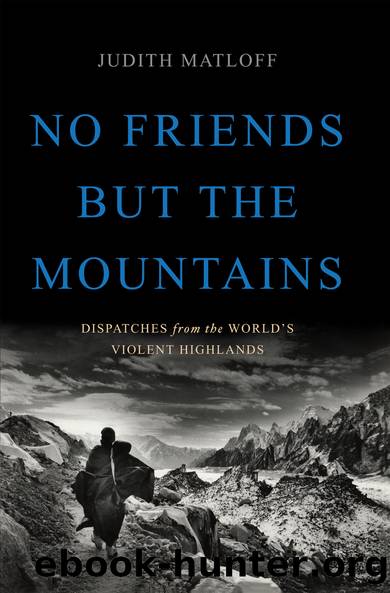
Author:Matloff, Judith [Неизв.]
Language: eng
Format: epub
Publisher: Hachette Book Group
Published: 2017-03-06T21:00:00+00:00
I first went to the region in the late 1990s, and returned in 2011. I was intrigued by how the landscape had shaped the clans and Islam, the two paradigms that fostered insurgency. According to the official version promoted by Moscow, Chechnya had unified under the leadership of the Kadyrov family. The rebels who operated in Chechnya by now had fled east to the rougher mountains in Dagestan, which couldnât seem to achieve any unity among its clans. The key to pacificationâor notâmight lie, I surmised, in how high and fractious the topography was.
I flew south from Moscow 990 miles with a translator and a checklist of sources to meet: human rights defenders, government representatives, religious leaders, agonized mothers whose sons âwent to the woods,â the euphemism for joining the jihadist armed underground.
It was noteworthy that we felt reasonably safe upon landing in Chechnya, seeing as how only a few years earlier, the republicâs capital, Grozny, had arguably been the most pulverized city on earth. Grozny translates as âterribleâ in Russia. It first adopted this moniker as a garrison town during the nineteenth century Caucasian war, and has remained true to its name. The last time I went there, in 1999, the bombardment was so massive that I couldnât get closer to the city than an hourâs drive away. Not that the word city applied at that point. Like most capitals of mountainous regions, Grozny is situated in one of the flatter areas, at an elevation of only 578 feet. This made it easy to attack from the slopes above. The Russians destroyed nearly every building. Half of the 470,000 residents had fled, preferring to squat in comparative comfort beneath tarps in refugee camps or in railway car shelters in the next republic, Ingushetia. Those who remained in Grozny hid in rancid basements lit by candles. They slept in their clothes and darted out during lulls in shelling to scoop water from ditches. Undetonated mortar rounds were stuck in their yards, and in the walls of their homes. Fires raged amid the shattered cement.
But the Russian military couldnât destroy the rebelsâ hideouts in the mountains. There the insurgents stood watch on nine-hundred-year-old towers overlooking ravines, staging ambushes on the few roads as Russian patrols rolled by. Just like in Colombia, that area was off-limits to the government, then and still today.
Compared to the nineties, however, it was now a cinch to reach Grozny, which had graduated to the UNâs list of fastest-growing cities, admittedly an easy qualification seeing that it was rising from nothing. Although the Russian troops had by now withdrawn, the republic was heavily militarized, thick with Chechen uniformed men who manned checkpoints on the main roads. We drove past villages that last time I visited were coiled with razor wire and lined with snipers, into a rebuilt city so pristine it felt like a theme park, literally. The gate to Grozny bore an eerie resemblance to the entrance of Universal Studios in Orlando, with the same unnatural yellow color and triumphant arch.
Download
This site does not store any files on its server. We only index and link to content provided by other sites. Please contact the content providers to delete copyright contents if any and email us, we'll remove relevant links or contents immediately.
The Vikings: Conquering England, France, and Ireland by Wernick Robert(84237)
Ali Pasha, Lion of Ioannina by Eugenia Russell & Eugenia Russell(40259)
The Conquerors (The Winning of America Series Book 3) by Eckert Allan W(37474)
The Vikings: Discoverers of a New World by Wernick Robert(36980)
Cecilia; Or, Memoirs of an Heiress — Volume 1 by Fanny Burney(32559)
Cecilia; Or, Memoirs of an Heiress — Volume 2 by Fanny Burney(31957)
Cecilia; Or, Memoirs of an Heiress — Volume 3 by Fanny Burney(31943)
Empire of the Sikhs by Patwant Singh(23089)
The Secret History by Donna Tartt(19097)
Hans Sturm: A Soldier's Odyssey on the Eastern Front by Gordon Williamson(18594)
Cat's cradle by Kurt Vonnegut(15362)
Pimp by Iceberg Slim(14515)
Sapiens: A Brief History of Humankind by Yuval Noah Harari(14392)
Talking to Strangers by Malcolm Gladwell(13375)
Norse Mythology by Gaiman Neil(13372)
Leonardo da Vinci by Walter Isaacson(13339)
4 3 2 1: A Novel by Paul Auster(12396)
Underground: A Human History of the Worlds Beneath Our Feet by Will Hunt(12100)
The Radium Girls by Kate Moore(12033)
